Rezoning and Land Use Planning in Town of Fort Myers Beach
Providing expert entitlement advocacy and strategic planning services for property owners and developers throughout the Town of Fort Myers Beach jurisdiction.
Typical Timeline
The Local Planning Agency makes a recommendation and the Town Council holds a public hearing and, in some cases, a second public hearing, at which it makes the final decision. The Town Council's decision on a land use ordinance amendment or adoption is final. Contested rezonings on the island frequently take longer than the procedural schedule suggests, and a denial followed by a revised resubmittal is a realistic outcome to plan for rather than an aberration.
Work in this jurisdiction
Pink Shell Resort and Marina Commercial Planned Development
Post-Ian redevelopment of a 10-acre resort on the north end of Estero Island, including a new hotel condominium component.
Salty Crab Commercial Planned Development Zoning
Post-Ian build back.
Estero Island Beach Club Commercial Planned Development and Special Exception Zoning
Post-Ian build back.
Outrigger Commercial Planned Development by London Bay
Initial submittal of the Commercial Planned Development. The application was later withdrawn.
Mosquito Control District Special Exception
Post-Ian build back.
Residential and Rental Build-Back Variances
Many additional variances for home and rental build backs involving setbacks, height, and intensity.
What is Distinctive Here
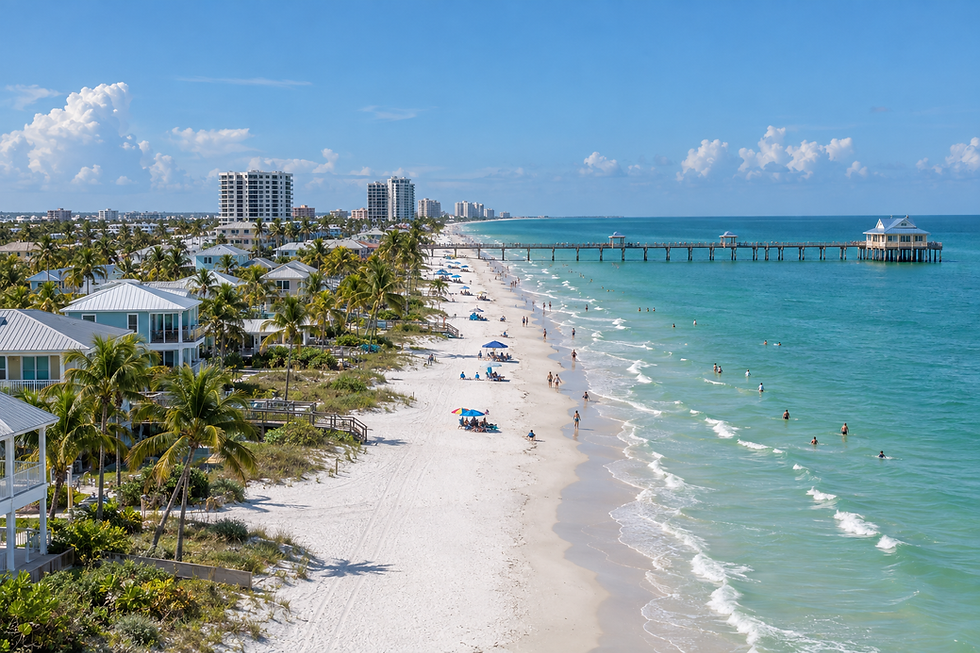
Fort Myers Beach is the most demanding entitlement environment in Southwest Florida, and it is the one where planning judgment matters most. Hurricane Ian destroyed much of Estero Island in 2022 and the Town has been rebuilding under intense scrutiny ever since — from residents, from the Council, and from a public with strong views about what the island should become. Nothing here is routine.
The Town’s Comprehensive Plan has strong community support for its restrictions on height and stories limiting most development to 35 feet over flood and three stories. Residents feel strongly about the restrictions being a significant part of maintaining the character of the island. Yet, the Comprehensive Plan allows for developments to exceed those limitations through the Commercial Planned Development process where, public benefits can be provided by the applicant in exchange for more height, stories and intensity, in an often publicly debated negotiation. This has proven to be confusing and frustrating for the public and equally so for the applicants as public benefit are not clearly defined by City Council, the Land Development Code or the Comprehensive Plan.
Three Constraints That Shape Redevelopment
Three constraints operate simultaneously and have to be solved together rather than sequentially.
01
FEMA’s 50 Percent Rule
FEMA's substantial improvement and substantial damage rules, commonly called the 50 percent rule, govern what can be repaired versus what must be rebuilt to current elevation and code standards. These requirements frequently determine whether a redevelopment is viable at all.
02
Town Development Standards
The Town's comprehensive plan and land development code establish height, density, and character limits that reflect a long-standing community position about scale.
03
Community & Council
The political environment is genuinely unpredictable, and an application that satisfies the code can still fail at Council if the community case has not been made.
The practical consequence is that redevelopment applications here are won on the record and on the relationship with the community, not on technical compliance alone.
Solving the Development Puzzle
Commercial Planned Development rezonings are the usual vehicle for resort and mixed-use redevelopment on the island. They require a Master Concept Plan that reconciles FEMA elevation requirements with the Town's height limits and with parking that has to fit beneath a raised structure.
This is a genuinely difficult design problem that is a planning problem before it is an architectural one.
Who decides what
Application type
Recommending body
Deciding body
Conventional Rezoning
Local Planning Agency
Town Council — final (two hearings)
Planned Development Zoning
Local Planning Agency
Town Council — final (two hearings)
Planned Development Amendment
Local Planning Agency
Town Council — final (two hearings)
Special Exception
Local Planning Agency
Town Council — final (one hearing)
Variance
Local Planning Agency
Town Council — final (one hearing)
Comprehensive Plan Amendment
Local Planning Agency
Town Council — final (two hearings)