Code Compliance and
Violation Abatement
An open code case is a lien risk, an obstacle to closing, and in most jurisdictions a fine that accrues daily. Most cases have a planning solution: the use is legal nonconforming, the structure can be permitted after the fact, or the site can be brought into compliance through an approval rather than a demolition. Which path you take matters, and so does how quickly you start.
When you need it
-
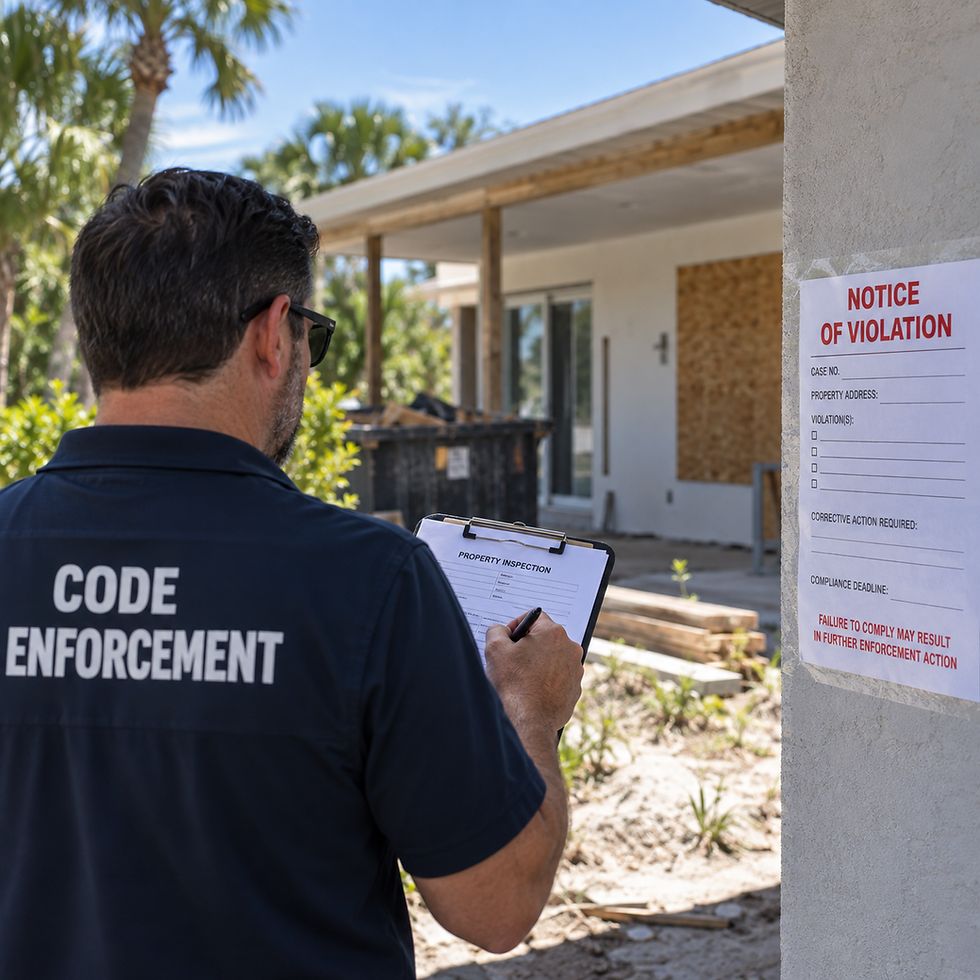
You have received a notice of violation or a code enforcement citation
-
A code case is holding up a sale or a refinance
-
An existing use or structure predates the current code and needs a legal nonconforming determination
-
Unpermitted work requires after-the-fact approval
-
Accruing fines need to be mitigated, or a lien needs to be released
-
A code enforcement hearing is scheduled
What GCPS delivers
-
Case review establishing what is actually alleged as against what is actually on the ground
-
Legal nonconforming use and structure research using historical aerials, permit history, and property records
-
Compliance strategy — after-the-fact permitting, variance, rezoning, special exception, or physical correction
-
Preparation and management of whatever application the chosen path requires
-
Representation at code enforcement hearings
-
Direct coordination with code enforcement staff, which frequently resolves a case without a hearing
-
Fine mitigation and lien release support
-
Written compliance documentation for closing
Typical timeline
Straightforward cases resolve in weeks. Cases that require an entitlement to cure run on that entitlement's schedule, although compliance deadlines can usually be extended once a good-faith path is documented.
What usually goes wrong
-
Nobody responds to the notice — fines accrue daily and compound. Code enforcement staff have meaningful discretion over timing and are generally willing to hold a case that shows a documented path to compliance. Silence removes that option and is the single most expensive thing an owner can do.
-
Nonconforming rights were never documented — legal nonconforming status usually exists but has to be proven, through historical aerials, old permits, utility records, and tax records. Owners assume grandfathering protects them and learn at the hearing that the burden of proof is theirs.
-
Fixing it before checking whether it can be permitted — correcting a violation by removing the structure is sometimes the most expensive option available. Establish whether it can be legitimized before you demolish it.
-
The case is found at closing — code cases run with the property. Title work finds them late and the transaction absorbs the delay. This belongs on the due diligence checklist.